
Training
The Alaska Native Epidemiology Center offers training workshops to build skills in core public health competencies within our Alaska Tribal Health System (ATHS).

Demography 101
Mar 31, 2026 10:00 AM AKT
Online/Virtual
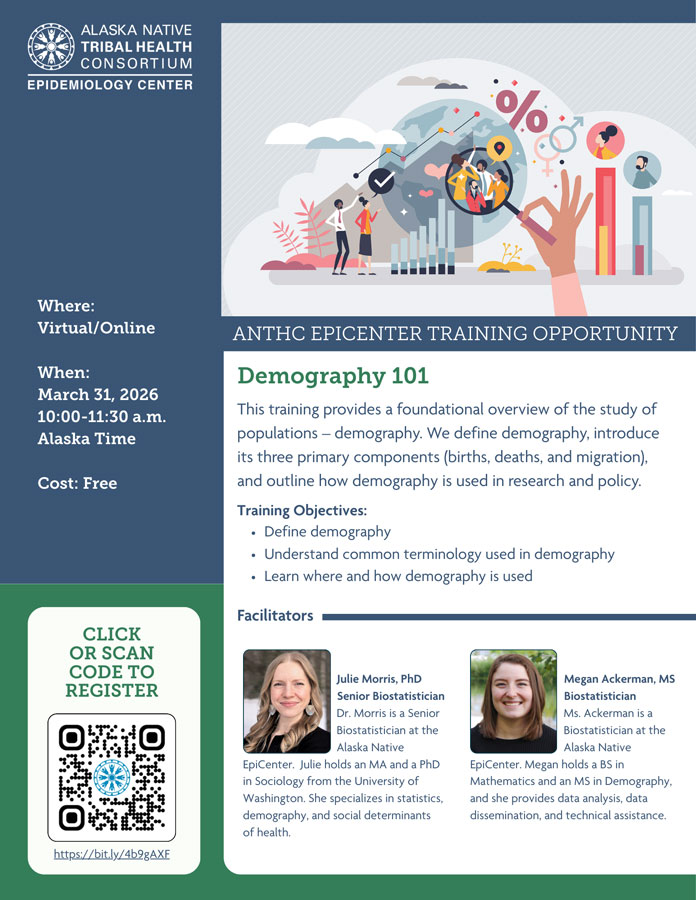
This training provides a foundational overview of the study of populations – demography. We define demography, introduce its three primary components (births, deaths, and migration), and outline how demography is used in research and policy.
Evaluation Planning
April 1 & 2, 2026 9am-12pm AKT
Online/Virtual
Every evaluation effort, large or small, should start with a plan. Evaluation plans clarify desired outcomes and help ensure stakeholders are on the same page. In this course, participants will learn about the importance of good evaluation planning, what to include in an evaluation plan, and how to use a plan after it’s been developed.
Upcoming Trainings Sponsored by the ANTHC EpiCenter
Demography 101
March 31, 2026 • 10-11:30am
This training provides a foundational overview of the study of populations – demography. We define demography, introduce its three primary components (births, deaths, and migration), and outline how demography is used in research and policy (Informational Training/Virtual).
Managing Federal Grants & Cooperative Agreements
March 26, April 2, & April 7, 2026 • 9am-12pm
Learn to effectively manage your federal grant awards! This course will help you develop a working knowledge of the grants lifecycle to manage your grant for compliance and results. This course will help you develop a working understanding of issues that affect day-to-day operations and federal grant management through a series of exercises and discussions. You will cover topics such as site visits to managing cost-share contributions throughout the period of performance (Training Workshop/Virtual).
Evaluation Planning
April 1 & 2, 2026 • 9am-12pm (2 sessions)
Every evaluation effort, large or small, should start with a plan! Evaluation plans clarify desired outcomes and help ensure stakeholders are on the same page. In this course, participants will learn about the importance of good evaluation planning, what to include in an evaluation plan, and how to use a plan after it’s been developed (Training Workshop/Virtual).
Using CDC WONDER to Track Substance Use in Alaska
April 8, 2026 • 10am-12pm
Participants will learn to create drug overdose-related queries in CDC WONDER, an easy-to-use, menu-driven system that has information resources available to public health professionals (Training Workshop/Virtual).
Data Storytelling
April 14 & 16, 2026 • 9am-12pm (2 Sessions)
Our brains are wired for stories. Therefore, the stories we integrate with our data can create more actionable information. Before writing another traditional 20 (or 50) page evaluation report, put on your communication and data storytelling hat, and join us for this online learning program that will teach you how to transform data and findings into visual stories that are cogent, engaging, and true to your analysis (Training Workshop/Virtual).
Applied Demography
April 21, 2026 • 10am-12pm
This 2-hour workshop provides participants a hands-on learning experience with basic measures and tools used in demography (Training Workshop/Virtual).
Intro to Data Management
In-Person Training
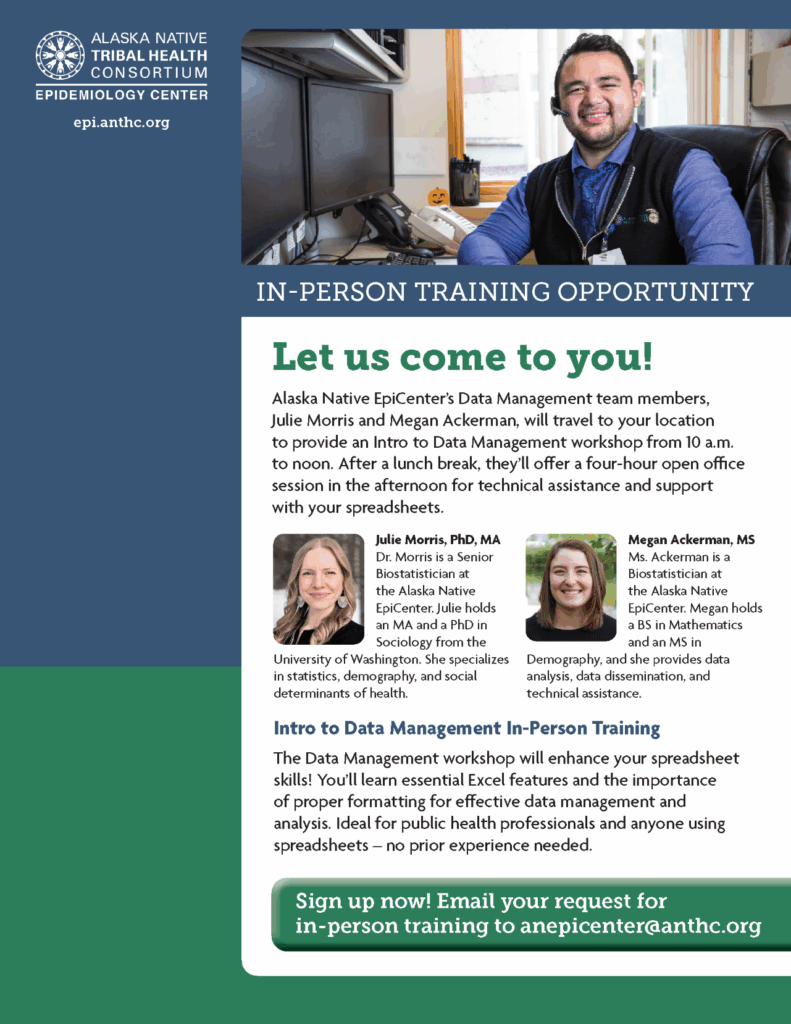
Let us come to you!
Alaska Native EpiCenter’s Data Management team members, Julie Morris and Megan Ackerman, will travel to your location to provide an Intro to Data Management workshop from 10 a.m. to noon (All times are AKDT). After a lunch break, they’ll offer a four-hour open office session in the afternoon for technical assistance and support with your spreadsheets.
Email your request for in-person training to anepicenter@anthc.org.
Using CDC WONDER to Track Substance Use Data in Alaska
This free training opportunity is sponsored and hosted by the ANTHC EpiCenter and presented by Tim Collins.
Join Senior Epidemiologist Tim Collins for a 2-hour CDC WONDER training, sponsored by the ANTHC EpiCenter, designed for Alaska Tribal health organization employees involved in substance use outreach, treatment, or analytics.
CDC WONDER (Wide-ranging ONline Data for Epidemiologic Research) is an easy-to-use, menu-driven system that has information resources available to public health professionals.
Participants will learn to create drug overdose-related queries in CDC WONDER, including number of deaths, crude mortality rate, and age-adjusted mortality rate. They will also learn to index results by various demographics and regions, and use built-in WONDER features to make charts, export, cite, and share their data.
This is a recurring event.
Past Trainings
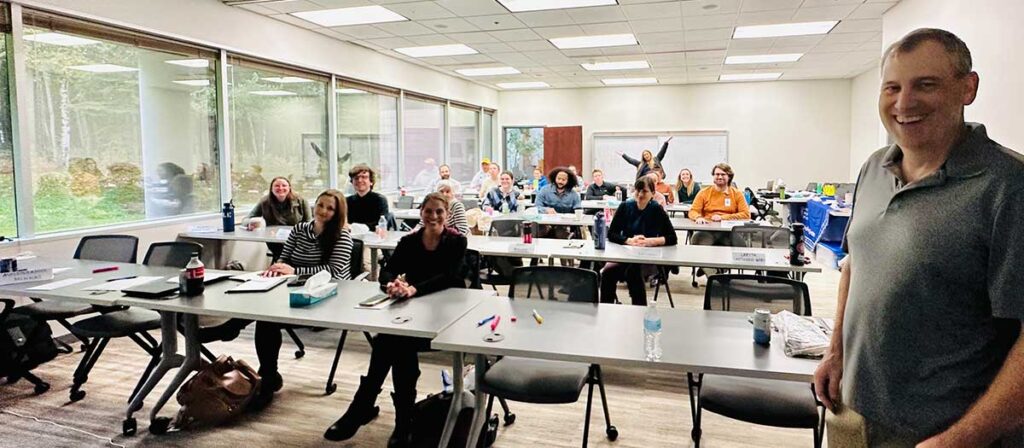
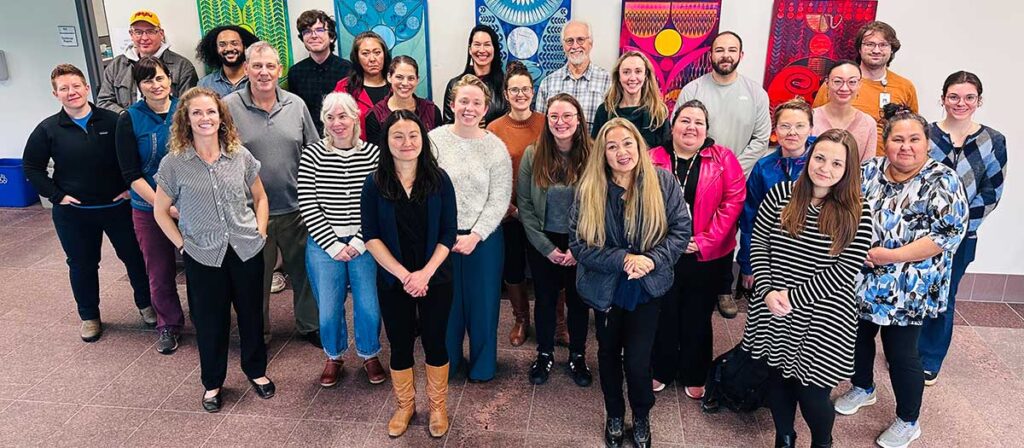
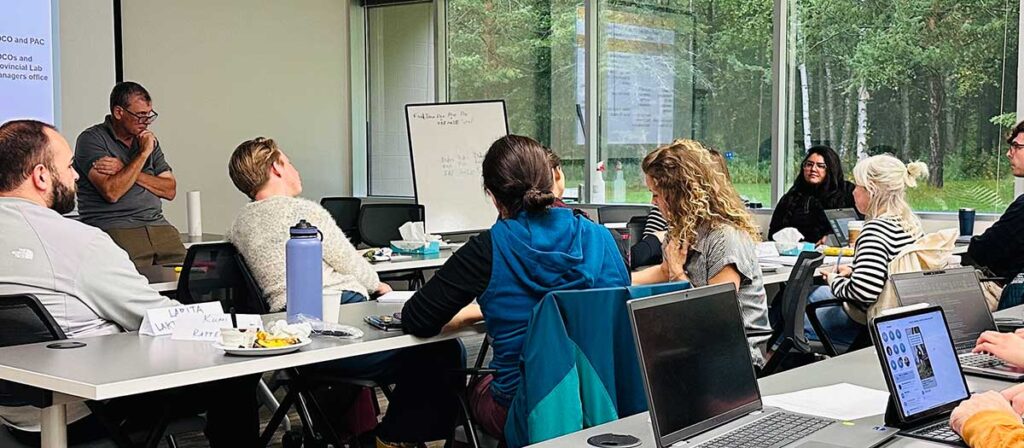
The EpiCenter runs several training workshops each year. Past topics have included program evaluation, grants management, health literacy, and many more. We provide scholarships to Alaska Native professionals and students to help build capacity in the Alaska Tribal Health System. Below is a list recent trainings supported and/or conducted by the EpiCenter. If you are a THO employee and would like to see these trainings again, please Contact Us.
- Alaska Native Epi Data Sources and Methods
- Applied Demography
- Avian Influenza Preparedness for Alaska
- Basic Applied Epidemiology for Public Health Workers
- CDC Wonder
- Cost Principles for Federal Grants
- Creative Narrations in Anchorage
- Data Sovereignty
- Data Storytelling
- Demography 101
- Evaluation Planning
- From Default to Dazzling
- Indigenous Evaluation
- Introduction to Data Management
- Introduction to Public Health
- Managing Federal Grants
- Project Management Essentials for Non Project Managers
- Public Health and Risk Communication Strategies
- Qualitative Research Methods
- R for Beginners
- Intermediate R
- Subawarding for Passthrough Entities
- Survey Design
- TOP Facilitation Methods
- Using CDC WONDER CDC To Track Drug Overdoses in Alaska
- We Are Nations